
You Can't Hate Yourself Thin
Getting the body I wanted didn't teach me to love it.

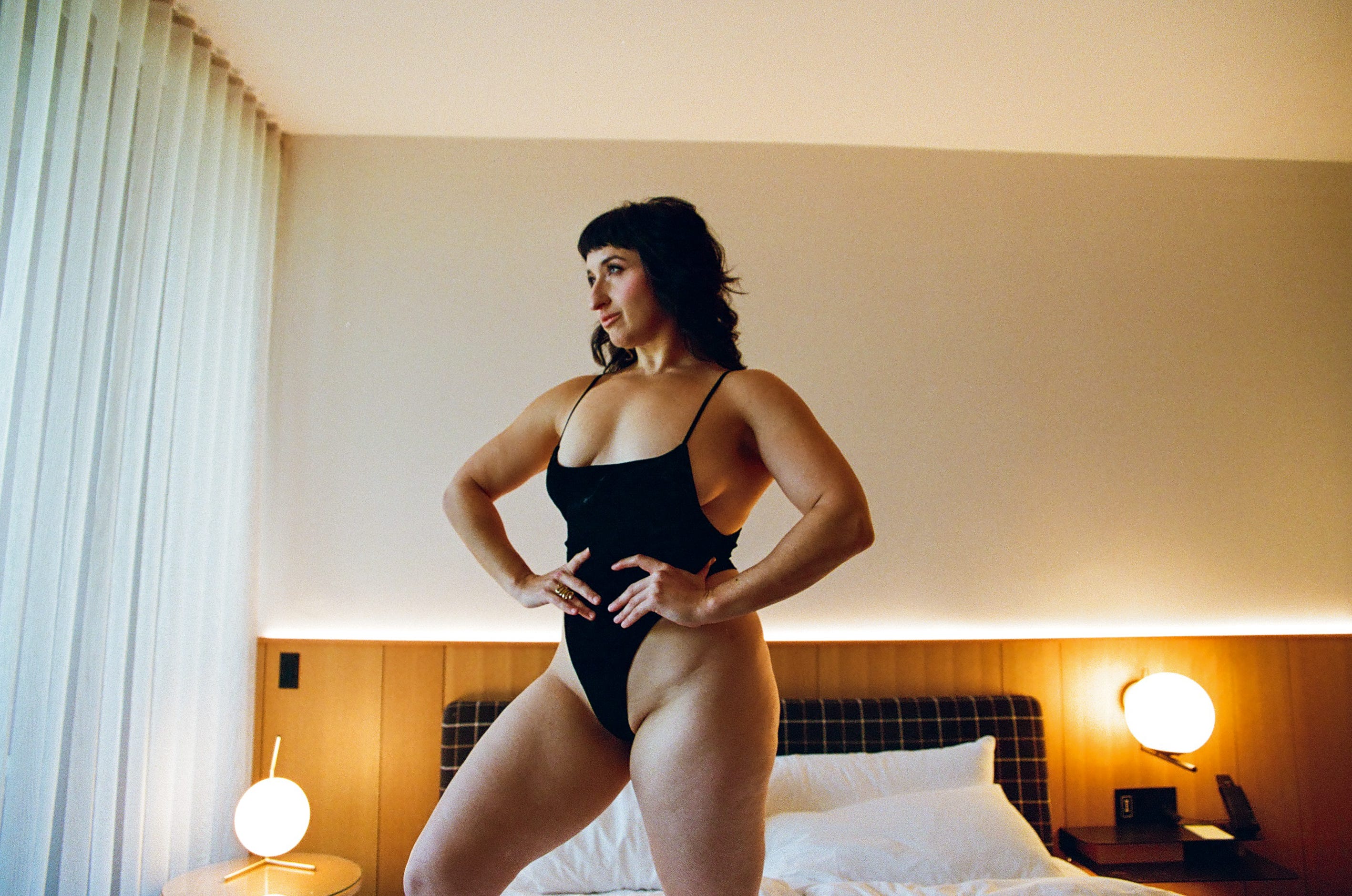
In fall of 2019, I achieved a lifelong dream: I hit my goal weight, the one I’d fantasized about since I was a teenager. I loved the way I looked. My abs were defined, my hamstrings popped, and clothes labeled “XS” fit a little loose.
I had never loved my body so much. I strutted around New York City in short shorts and crop tops. I got married in a catsuit like Angelina Jolie. I felt a sense of benevolent superiority about all this. I had succeeded where so many had failed. I spent months giving out free weight loss advice to the many women who messaged me asking how I did it.
“Self-love,” I would say. “You can’t change your body if you don’t love it—wherever it’s at now.”
I really believed in that answer, because it was true. The only times I was ever able to achieve intentional weight loss were times when I was able to really love myself and take that harsh disciplinary vibe off of the gym visits and calorie restriction. Changing my relationship with my own body from one that felt hostile and combative to something loving and gentle was my weight loss “secret.” It made it more like a fun game than a rigorous challenge. I had outgrown my old toxicity around my body.
Or so I thought.

Winter 2019. I spent the holidays eating whatever I wanted. I was newly married and moving to a new state. My body was rocking, and I was confident it would stay that way, because as I stated before, I WAS HEALED.
Then the number on the scale started going up each week, and my emotional response was to feel tremendously guilty and ashamed.
Guilt? Shame? Over gaining a few pounds? I thought I was past this.
The guilt made food less enjoyable but also totally irresistible. I was compulsively overeating daily and shaming myself for it. I would fast the following day, and then I’d compulsively overeat again in the evening. I started panicking every time I went to put on my new “skinny” clothes, scared they would no longer fit.
When January rolled around, I had gained back most of the weight I’d lost. I resolved to start up concerted weight loss efforts again in the new year. I thought it would be easy, because I WAS HEALED.
I wasn’t.
February 2020. I went on a 9-day work trip to New York City, where I ate fabulous food every day, because it’s New York City. I arrived home wanton and frisky, excited to rub up against my husband a little. But when I went to the bathroom to shower, I saw my naked body in the mirror, and the gears of my internal sex machine screeched to a shuddering stop.
I looked swollen and puffy. I thought I looked monstrous. My abs were hiding under a cushion-y layer of fat. My hamstrings were no longer poppin’, and my belly was muffin-toppin’.
And I hated it. I hated the way my body looked. I hated my body.
GOD DAMN IT.
I wasn’t as healed as I thought.
Crying at my own reflection and fighting back waves of self-loathing at the sight of softness in my belly doesn’t exactly support the claim that this was all coming from a place of self-love.
Growing up, I never had a healthy relationship with food or my body, which makes sense. My whole family worked to instill twin fears of food and fat in me from a very young age.
One of my earliest memories has a five-year-old me trying to get a piece of bologna—or baloney, as I called it—from the refrigerator. My older brother slapped it out of my little hands, warning me that eating that way would make me fat.
I’m telling you, that shit changes you.
As a kid, I ate when I was supposed to eat, which was whenever anyone put food in front of me, not in response to hunger cues. Because the adults around me had made it clear I shouldn’t enjoy food too much, I always wanted as much of it as I could get. I’d eat everything that was put in front of me and as much as I could sneak.
In high school, I started noticing a strange, hollow feeling in my stomach every morning around 10am, and I had no idea what it was. All I knew was it was extremely uncomfortable, but it would eventually pass if I ignored it. It was a mystery for years.
My senior year, my mom and I did the Atkins diet together, and I lost weight for the first time ever, huzzah! Then I plateaued, probably because I was eating huge quantities of low-carb cheesecake, buffalo wings, and bacon, and virtually nothing else.
One day, I found myself staring at a slice of watermelon, tears streaming because I wanted to eat it and my stupid fucking diet said I couldn’t.
That was it for the Atkins diet. I ate that goddamn watermelon, and I gained all those pounds back.
Oh, and I finally figured out that that hollow feeling was hunger when I had to feed myself for the first time in college.

In my mid-20s, something shifted. I had an epiphany after starting a new relationship: I realized I was carrying a deep belief that no one would ever love me. Romantically, I mean. I believed deep down I would never find love. ~cue rainy window & dramatic strings~
But then I did. I had this new boyfriend who loved me and I loved him, and also I’d just fallen in love with Daniel in Korea and had amazing sex for the first time ever, and oh my goddess, not only was I lovable, I was also desirable, and whoa, I never thought…I never thought I was either of those things.
It sounds ridiculous, but I was gobsmacked by this. I thought I had high self-esteem. The truth was I had been faking confidence and self-worth since I was a kid. I didn’t actually love myself, and if I wanted to give myself my best chance in life, I needed to start now.
And I realized…I wanted to give myself my best chance in life. At the time, I believed succeeding as a performer meant making my body smaller.
I decided to at least act as if I was worth putting in effort for. Changing my body stopped being a moral issue and became about my career. I wasn’t a “bad” person trying to make myself “good” by losing weight. I was a beautiful person trying to make myself more marketable as a performer.
Just like that, the weight loss that had eluded me my whole life became easy. The process was simple and joyful, and I never felt restricted or deprived. It was all coming from a place of love for myself, of belief in my worthiness as a human being, and it was easy.

Back to 2020—here I am, 36 years old, crying into my husband’s chest as his hopes of getting laid slowly die, whimpering incoherently about how I’m a failure and I’m fat again and I don’t feel sexy, barely hearing his gentle reminders that when I first got undressed, he loved what he saw.
I’ve gained back all the weight I lost, and even though I’m still at a healthy weight, that’s enough to make me look in the mirror and hate myself.
This isn’t self-love. This isn’t a positive relationship with food or my body. I might have started out this most recent weight loss journey with self-love vibes, but I had gotten so attached to the sense of moral superiority I developed once I hit that stupid goal weight. My new ab-tastic body had become part of my identity, and losing it so quickly made me feel defeated.
This is what happens when your love for your body is based on how it looks.
I now understand viscerally that loving your body cannot be based on how it looks.

That night was a turning point for me. I felt like a hypocrite — preaching self-love and body positivity but subconsciously holding myself to unreasonable beauty standards and measuring my value against them.
I’ve stopped trying to lose weight for the time being. Instead, I’m working on cultivating an unconditional love for my body and myself. I’m doing cheesy but effective exercises, like looking at myself naked in the mirror, flexing and arching and flaunting, telling myself how sexy and delicious I am at any weight. I’m consciously trying to reprogram my vision, to see belly rolls and sweet little overhangs of fat and think, “Mmm, yum!” instead of “Ew, gross.”
The “ew, gross” is something I learned. It’s not inherent. I remember being four years old and learning that fat was gross. I remember a hazy earlier life where I didn’t think like that.
If it was learned, it can be unlearned. I will unlearn it. I am unlearning it.

I don’t think there’s anything wrong with having aspirational fitness goals, or even aspirational aesthetic goals, but let my story be a cautionary tale. Changing your body gets tricky when you start attaching your worth to it.
Because like we all learned in grade school, our value is not based on looks. It can’t be. No matter what the media pushes. No matter what our culture obsesses about. We don’t have to subscribe to that shit. We can free ourselves.
We can modify our vision instead of our bodies. We can learn to see softness and dimples and scars and normal human contours as beautiful.
We can value our bodies for how they carry us through the world and the kindness of the hearts they house.
Thank you for sharing this so honestly and bravely. Like you, I've struggled with accepting my size and body image since childhood (my mother was always starving herself and encouraged me to do the same). Weight is especially tricky because I can be feeling great about myself, then step on the scale and be appalled by a number that seems completely disconnected from how I experience my body. Same with photos; I'll be out having a great time and feeling attractive, then someone will snap and share a pic and I'm immediately horrified: "Do I really look that fat?" 😩
That programming from childhood is really hard to undo, I know from experience! FWIW, I think you look great.